Diagnosis: adoption signals that matter.
Most AI pilots stall for lack of metrics. How to measure adoption from day one so your pilot doesn't become an endless experiment.
🚨 Why do most AI pilots get stuck in exploration?
The pattern is always the same: organizations start with enthusiasm, see initial results… and then stall at very low levels of adoption.
Why does this happen? There are several reasons. One that shows up constantly is the absence of monitoring and clear metrics from the start.
- Pilots launch without specific success criteria, making it hard to validate the strategy.
- There are no decision thresholds: without criteria to scale, iterate or discard, pilots become endless experiments.
- There's no baseline or target. What was the initial adoption? Is it growing? How much time did we save? Without that, there's no way to measure real impact.
In our experience, the clients who achieve sustainable adoption have something in common: they measure from day #1 and refine their metrics constantly.
That's why at Kintara, one of the first things we do is:
- Measure where they stand today.
- Define adoption metrics relevant to their context.
- Monitor and refine them monthly.
Because a well-structured dashboard doesn't just show where you are. It shows where to evolve as adoption itself evolves and grows more sophisticated.
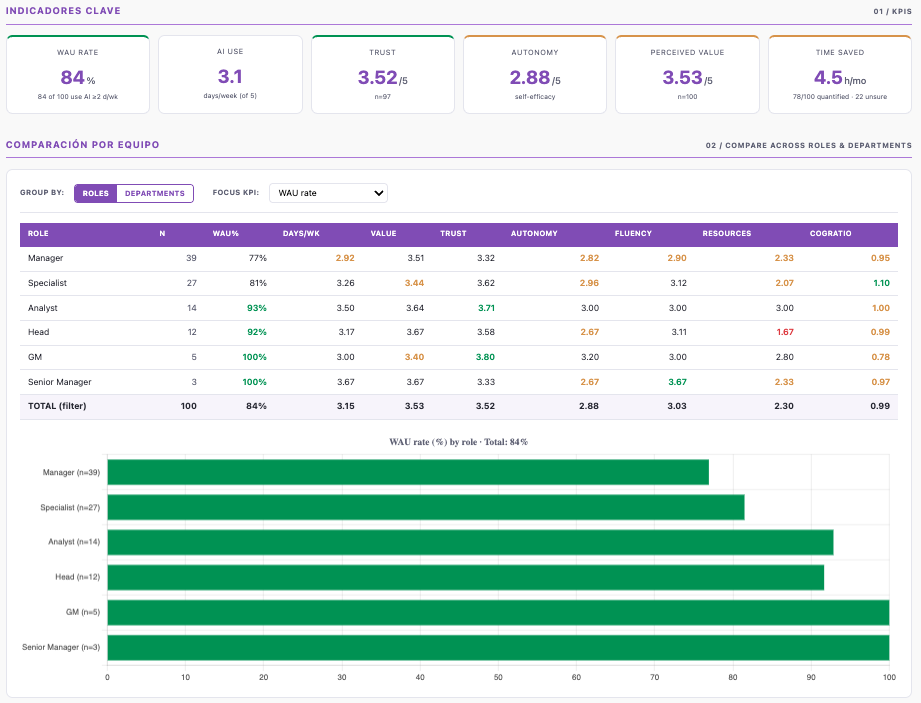
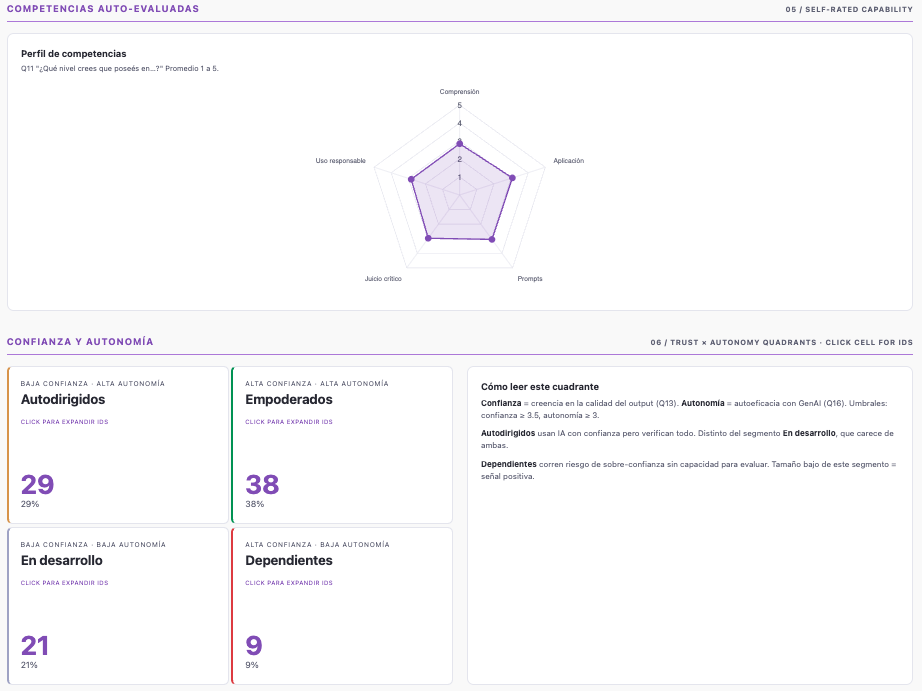
Below, an example with fictional data of how we visualize adoption: key indicators, comparison across teams, self-rated capability, and segmentation by trust and autonomy. We usually complement it with harder usage metrics pulled directly from the client's LLM.
In your organization, do adoption metrics evolve with usage, or do they stay the same?